Why a Commerce Agency Builds Its Own Products

Most commerce agencies sell time: developers, designers and project managers, billed by the hour or the sprint. ForkPoint does that too. We’ve built and supported e-commerce stores for more than 11 years, starting with Salesforce Commerce Cloud (SFCC). But alongside client work, we also build and run our own products.
If you’re evaluating us as a partner, or thinking of joining the team, that can look like a distraction. This article explains why we do it, who is behind each product, and why we think it makes our client work better, not thinner.
In short:
- Every product started as a client problem we kept solving by hand, project after project.
- ForkPoint owns, builds and supports all of them. The people behind the products are the same people who deliver client projects.
- Together they cover the life of a store: building, testing, monitoring, product data and AI discovery.
The Client Problem Behind Each Product
None of our products started as a business plan. Each one started when the same problem came up on enough projects that building a tool was cheaper than solving it by hand again.
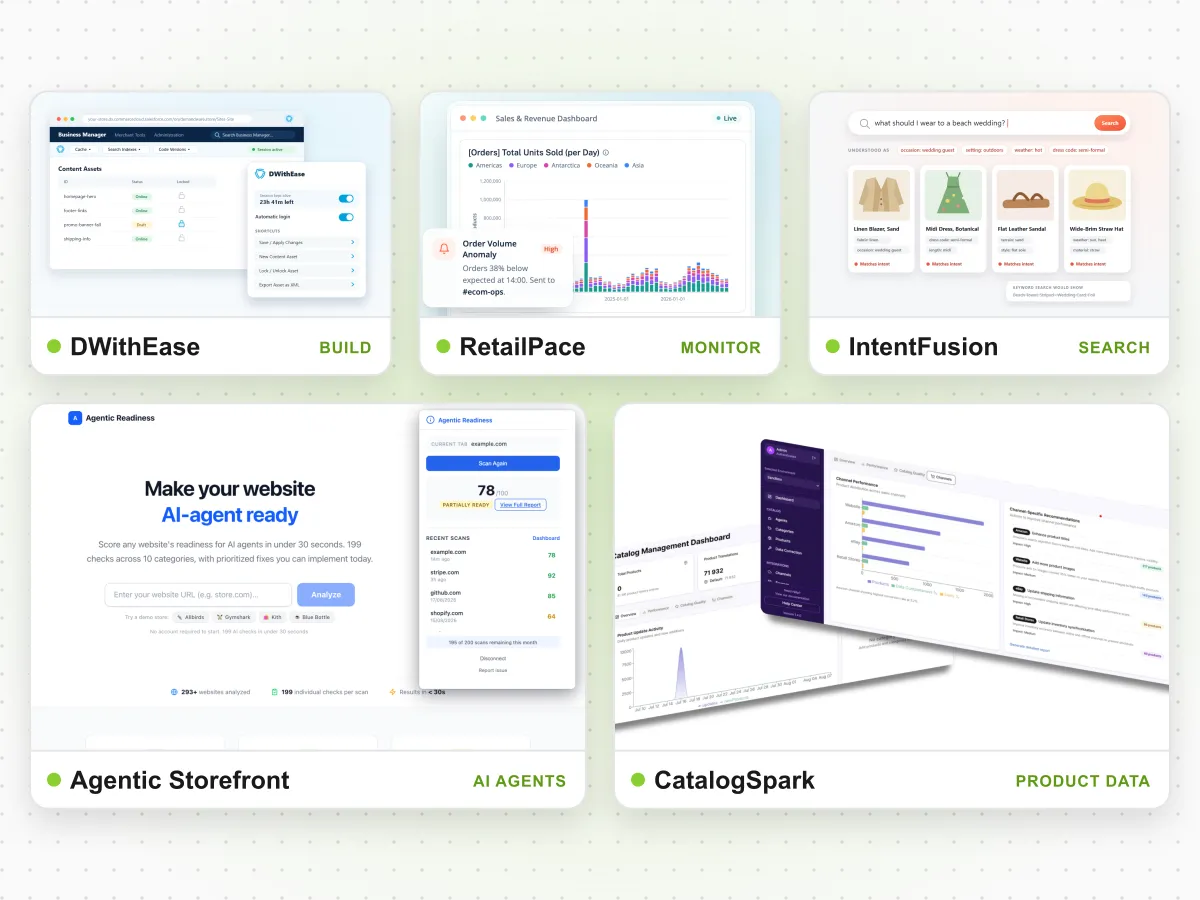
| Product | The problem we kept seeing | What the product does |
|---|---|---|
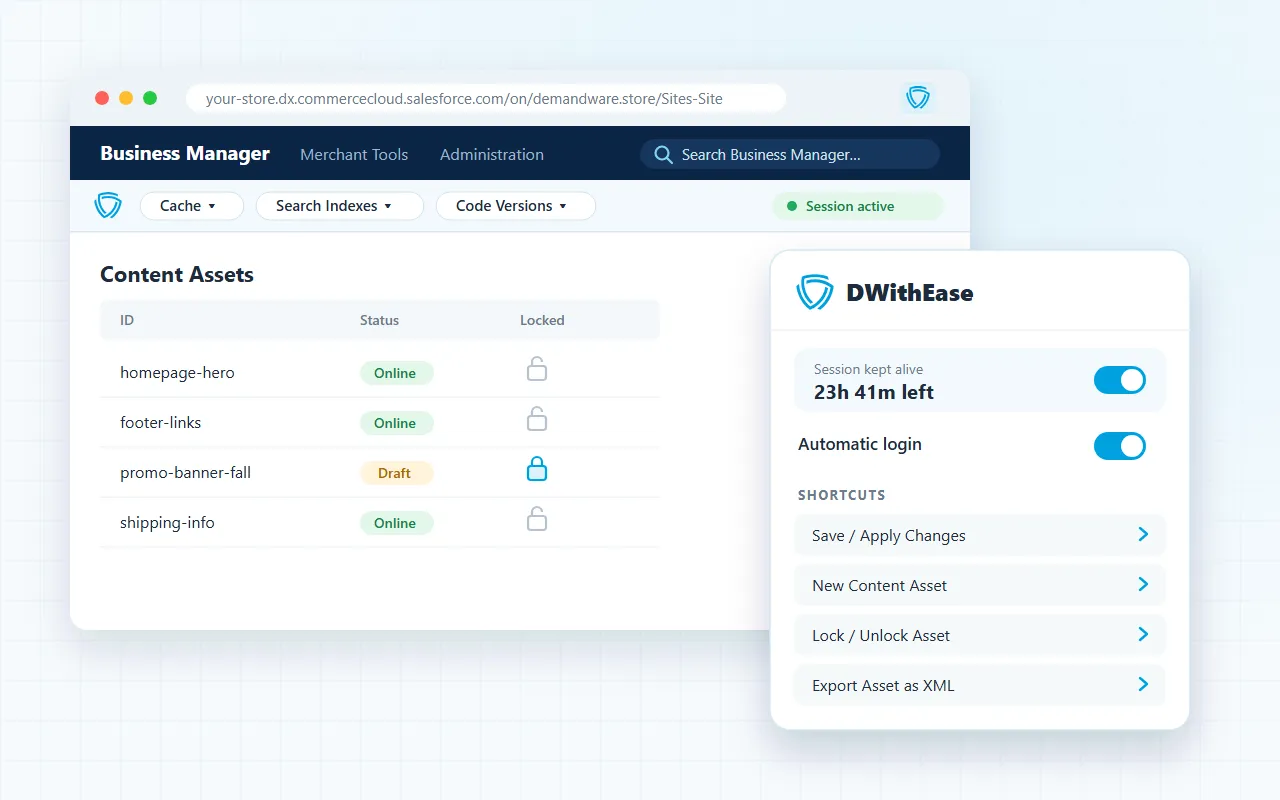
| DWithEase | SFCC developers losing hours to logins, slow menus and sandbox confusion | A free browser extension that removes everyday friction in Business Manager |
| RetailVerify | Releases breaking things that used to work, because manual testing took days | Automated regression testing of the shopper journeys that matter on SFCC |
| RetailPace | Customers finding problems before the team did | Monitoring of logs, errors, jobs and performance, with alerts before customers notice |
| CatalogSpark | Catalogs too large and messy to enrich, translate and publish by hand | AI-assisted product data enrichment, versioning and publishing to every channel |
| Agentic Storefront | Brands missing from AI assistants’ answers, and agents unable to buy | AI visibility and agent readiness: assessment, implementation and monitoring |
| IntentFusion | Shoppers not finding products they were looking for in on-site search | AI search, filtering, recommendations and chat for on-site product discovery |
DWithEase is the clearest example. Our own SFCC developers were tired of repeating the same Business Manager steps, so they fixed them one at a time. Once the tool worked for us, we released it to the SFCC community for free. Today it’s used by more than 25,000 SFCC professionals. We tell the full story in Building DWithEase, and on the DWithEase about page.
RetailVerify came from release work. Stores that tested by hand released rarely and still shipped regressions. With automated tests, Stine Home + Yard went from a release every few months to one or two a month, and cut testing from four person-days to two hours. Read the Stine case study or learn more about RetailVerify.
RetailPace came from support work. Too often, the first sign of a broken checkout or failed import was a customer email. RetailPace watches the store and alerts the team first. It’s the platform behind our monitoring package.
CatalogSpark came from catalog projects where product data was the bottleneck: supplier data in every format, missing attributes, and new channels each needing their own feed. With it, Stine Home + Yard grew its catalog from 35,000 to 80,000 products. See CatalogSpark on our products page.
Agentic Storefront answers a newer question. Clients started asking why AI assistants didn’t recommend them, and how AI agents could buy from their stores. Agentic Storefront answers both, and is built by the team behind DWithEase.
IntentFusion works on the other side of discovery: helping shoppers who are already on the site find what they mean, through AI search, filters, recommendations and chat.
Who Builds, Supports and Funds Them
All six products are owned by ForkPoint, not by a separate product company.
- Built by our engineers. The developers who build the products also work on client projects. Product work sharpens client work, and client work tells us what the products need next.
- Supported by the same team. When a client uses one of our products, support comes from people who know both the product and the store it runs on.
- Funded by ForkPoint. Product development is funded from our own business. One innovation project, a platform for monitoring and analysing e-commerce data, was also co-funded under an EU programme.
This has a practical upside for clients: no tool in the chain belongs to a vendor we don’t control. If a product needs to change for a client, we can change it.
How They Fit Together
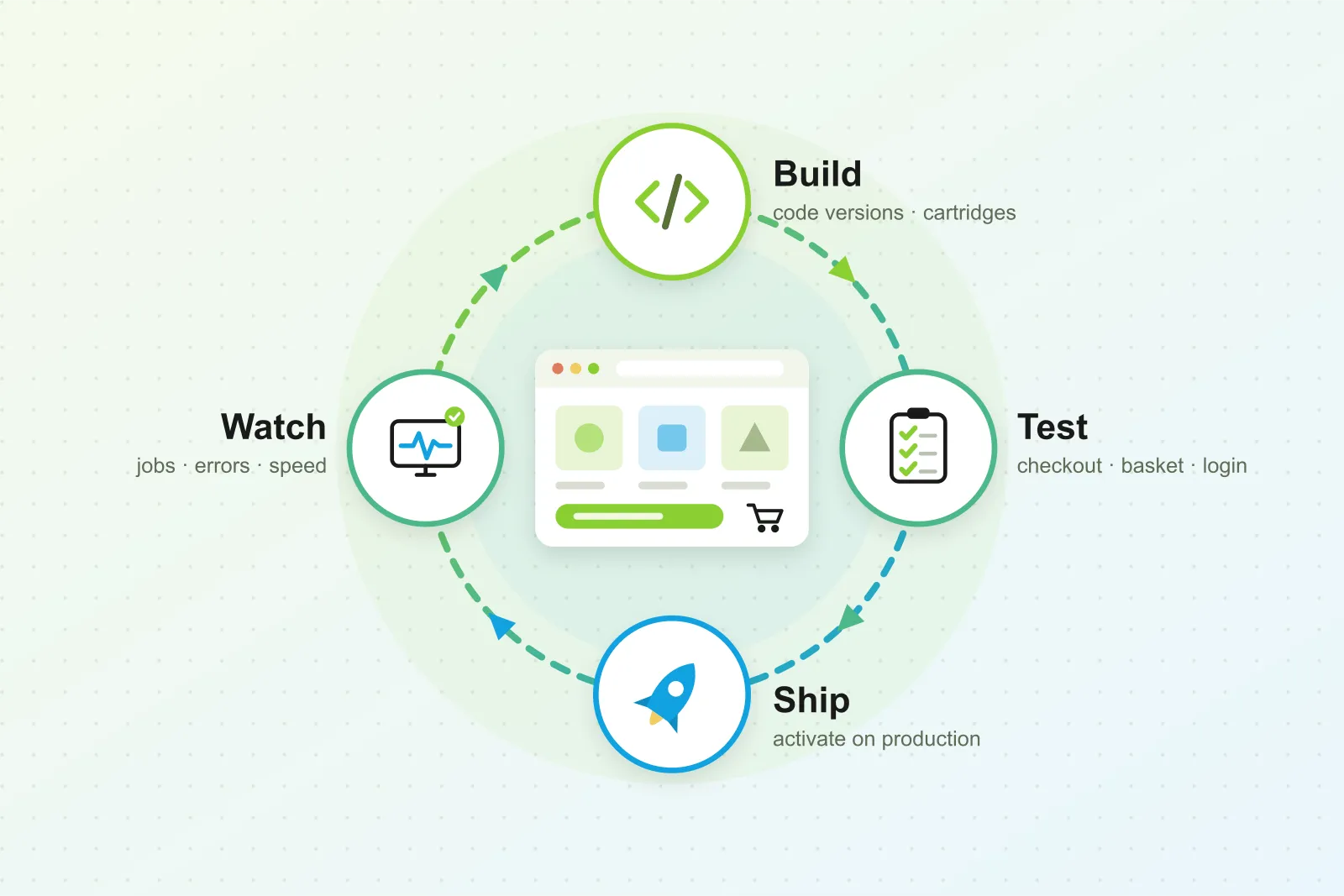
Each product covers one part of running a commerce store. Together, they follow the life of a store from code to customer:
- Build: DWithEase speeds up everyday SFCC development and deployment.
- Test: RetailVerify checks critical journeys before each release.
- Monitor: RetailPace watches the live store and alerts the team.
- Data: CatalogSpark keeps product data complete, translated and in sync across channels.
- AI discovery: Agentic Storefront makes the store visible and buyable in AI assistants, while IntentFusion improves discovery on the site itself.
The products work on their own, and a client can use just one. But they share a view of how stores fail: at a release, in production, in the catalog, or in a channel nobody is watching. For how the first three fit into a single release, see build, test, ship, watch: the SFCC release cycle. For how they help during a platform move, see replatforming without losing your data, your tests or your AI visibility.
Why This Matters If You’re Choosing a Partner
Building products changes how an agency works:
- We find the root cause. A tool only gets built when a problem repeats, so we’re used to asking why it keeps happening.
- We know the platforms deeply. Keeping a tool working for thousands of users means following every platform change closely.
- We think about the next year, not only this sprint. Products have to be maintained, so we design client work to be maintained too.
- You can check our work. DWithEase is free and public. Install it and judge the quality for yourself.
Why This Matters If You’re Joining Us
For developers, product work means variety: client projects on SFCC, Shopify and other platforms, plus products used by real customers every day. You’ll see how a feature performs in production for thousands of users, not only for one client.
- Read our story.
- See all ForkPoint products.
- Explore careers at ForkPoint.