Product data for AI shopping: five facts to get right

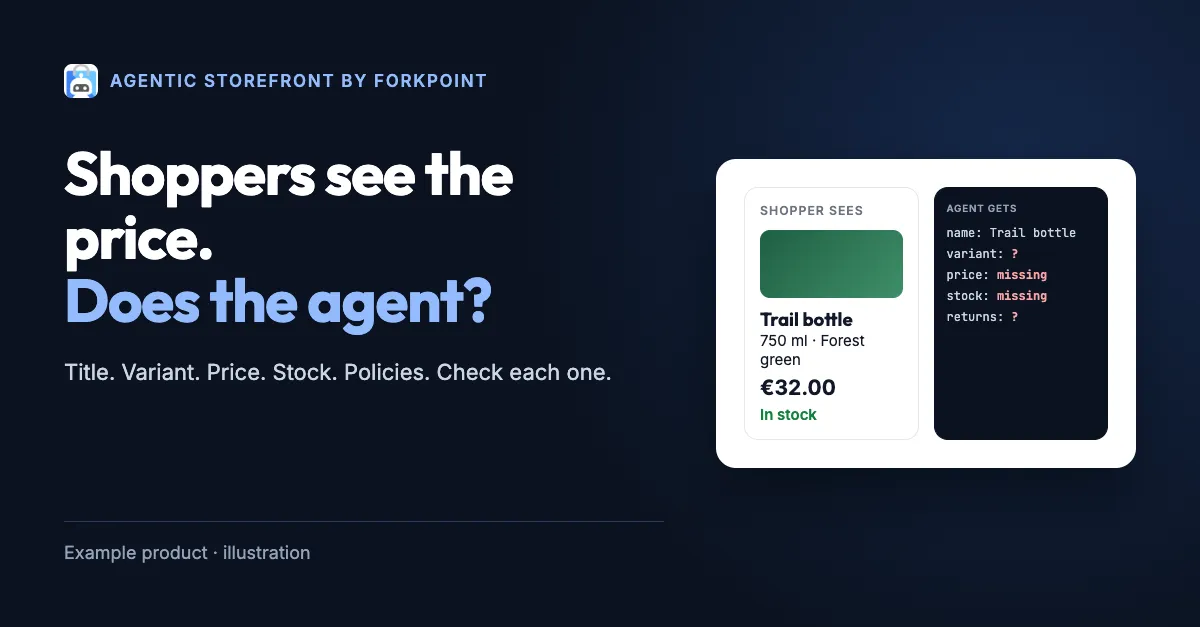
Product data becomes useful when a buyer can understand it and a team can verify it. Start with one item. Follow its title, variants, price, availability, and policies through the page and the systems that supply it. Fix disagreements at their source.
This guide uses a fictional 750 ml trail bottle. Its forest-green variant costs €32.00. The example lists it as in stock and links to a 30-day return policy with conditions. These values illustrate a review. They are not customer evidence or a recommended commercial offer.
Give the product a clear identity
A title should identify the item without forcing a reader to decode a campaign phrase. “Trail bottle, 750 ml” is more specific than “Your next adventure starts here.” Marketing copy can still explain the benefit. It should not replace the facts that identify the product.
Check whether the page, structured data, and feed refer to the same item. Keep stable product identifiers where the system supports them. Record the exact product and variant in your review so another person can repeat it.
An identifier does not need to carry the entire description. Keep names, dimensions, and other attributes in their proper fields. Avoid packing unrelated values into one title when a channel expects separate attributes.
Make variants unambiguous
The example bottle comes in forest green. A different colour or size might have a different identifier, price, or stock level. Review the selected variant rather than treating the entire product family as one interchangeable record.
Ask what happens when a visitor follows a variant link. Does the page keep the selection? Does the displayed price belong to that option? Does structured data describe the same offer? Check a second variant to see whether the template updates all relevant fields.
If a feed combines related products, inspect that grouping separately. Shopify’s product discovery guidance describes mapping and grouping for eligible catalog products. The correct setup depends on where the store keeps its attributes and how its products relate.
Keep price and currency together
A value of “32” needs context. The example uses €32.00. A live review should also account for the market, tax presentation, promotion, and selected variant. Record the conditions before comparing systems.
Compare three places: the visible page, the initial page response, and the product data supplied to the relevant channel. They may update at different times. A mismatch requires a trace through that flow, not an assumption that one system is always correct.
For a scheduled promotion, check the start and end conditions. Confirm that the regular and sale prices carry the intended meaning. Do not add a fixed value to a template as a shortcut. The next price update would create the same problem again.
Check what availability means
“In stock” is useful only when it refers to the correct product, variant, and market. Check whether the record describes sellable inventory, a warehouse total, or a backorder promise. Those values can differ for valid business reasons.
The review should identify which system owns the availability shown to a buyer. If an inventory change passes through a feed or cache, record the expected delay. Then test a change under controlled conditions.
A page-readiness audit can expose signals on the page. It cannot establish that every inventory record in every downstream channel is current. Keep a separate feed check when that question matters to the business.
Put policies within reach
Delivery and returns help buyers assess an offer. Link the relevant terms from the product page. State the region and the conditions behind the promise. Avoid a short label that hides important exceptions.
For the fictional bottle, “30-day returns” is incomplete without the policy. A real policy might depend on product condition, category, or destination. The content owner should confirm the wording with the team responsible for the service.
Use the same approach for specifications and warranties. Replace vague claims with supported facts. Keep evidence current when the product changes. A clear policy is useful to people and gives tools readable information; it does not guarantee an AI recommendation.
Record a review your team can repeat
Use a small evidence table for one product:
| Field | Example value | Review question |
|---|---|---|
| Identity | Trail bottle, 750 ml | Do all sources refer to this item? |
| Variant | Forest green | Does the selection persist? |
| Price | €32.00 | Do value and currency agree? |
| Availability | In stock | Does it apply to this variant and market? |
| Returns | 30 days, subject to policy | Can the buyer read the conditions? |
Save the page URL, date, market, and evidence. Assign each disagreement to the system owner. Define a check that will show whether the change worked. If a source cannot be inspected, record that limit rather than calling the product complete.
After a fix, repeat the comparison under the same conditions. Keep the specific result alongside any new score. This makes the handoff useful to the next engineer or merchandiser.
Get the free Shortlisted playbook for the full 30-day plan. Use the report walkthrough when you are ready to turn a page finding into a task.