E-commerce is changing. Can AI agents read your store?

A buyer can ask an AI assistant to compare products before visiting a store. That creates a practical question for a commerce team: can the tool find clear, current facts about what you sell? Start with one product page. Check the information. Give the next task an owner.
AI commerce can involve several different paths. A tool might retrieve a web page, use a product feed, or work through a supported channel. Some journeys return the buyer to the merchant. Others use a checkout within the channel. Those differences matter when you decide what to test. One broad label cannot describe every path.
Start with what your team controls
The Shopify product discovery guidance describes how eligible products reach AI channels through its catalog and sales channels. It also explains that eligibility and data mapping affect what a channel can use. Check the current rules for your store and market.
Your team still owns a useful first step: review the facts on a key product page. Is the title clear? Does the page show the right variant? Is the price current? Can a buyer find the delivery and return terms? These questions lead to work you can assign without making a large platform decision first.
Treat this as a bounded check. Select one URL, one market, and one variant. Record the date. A store can show different information by location, currency, customer status, or selected option. If two people inspect different conditions, they may reach different conclusions without either result being wrong.
One product makes the problem concrete
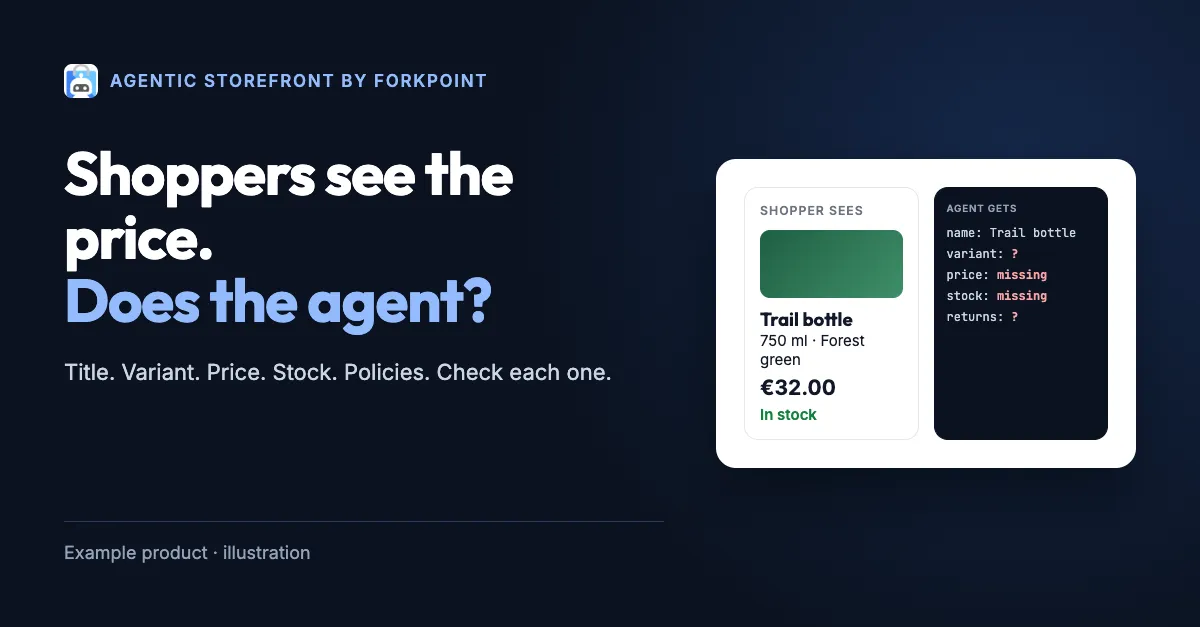
Consider a fictional 750 ml trail bottle. Its page shows a forest-green variant at €32.00. It lists the item as in stock. It also links to a 30-day return policy with conditions. These are teaching examples, not claims about a customer store.
Now suppose the visible page updates the price after JavaScript runs, while the initial HTML contains no price. A tool that reads that initial response may miss information that a person sees. That observation gives an engineer something specific to inspect. It does not prove that every AI tool misses the price.
The next step is to check how the page delivers the fact. Compare the initial response with the rendered page and the product data for the same variant. If they disagree, identify which source owns the value. Avoid fixing a single hard-coded price when the underlying template or data flow needs the change.
Check whether tools can reach the page
Start with access. Review the page response and relevant crawler rules. A normal browser visit does not prove that every client receives the same content. A bot rule, login requirement, or protection layer can change the response.
Keep access decisions deliberate. Some routes should remain private. A readiness task is not an instruction to remove all protection or let every bot use every endpoint. Identify the intended public page and the clients you mean to support. Then test the policy against that scope.
A useful finding includes the requested URL, the response, and the check conditions. If the scanner encountered a temporary failure, repeat the request before treating it as a stable defect. Give the infrastructure owner enough evidence to distinguish a policy decision from an accidental block.
Check the facts a page exposes
Review the product title, description, selected variant, price, currency, and stock status. Look for meaningful text rather than information available only inside an image. Make labels specific enough that a reader can connect a value to the right option.
Then compare visible content with any structured product data. A mismatch is worth investigating even when the page looks correct. The team should be able to explain where each value comes from and how updates reach the page. A scheduled price change is a useful example: which system changes first, and what happens during the gap?
Feed validation is a separate check. A page scan does not establish that every channel receives the correct feed record. Use the product-data guide to trace one product through the page and its data sources.
Check the proof behind the claim
“Premium quality” gives a buyer little to inspect. A material, dimension, warranty term, or documented test gives them a more useful fact. Choose claims that your team can support. Keep the supporting evidence accessible and current.
The same care applies to delivery and returns. State the relevant region, conditions, and exceptions. Link to the policy from the product page. A buyer should not need to guess whether a delivery promise applies to their order.
Do not add invented ratings or customer results to make a page appear more credible. When evidence is missing, define the work needed to obtain it. Clear limits help a team make a sound decision about what it can publish.
Check the action separately
Reading a product is different from buying it. An agent interface or protocol signal can indicate a possible action path. It does not prove a successful transaction.
A purchase test needs its own scope. Identify the supported client, market, payment method, and test environment. Define the expected result and the handling of failures. Keep those checks separate from a public page audit so that a readiness score does not become an unsupported checkout claim.
This separation also makes the handoff clearer. Content owners can improve product facts. Engineers can correct rendering and access issues. Commerce operations can validate inventory and policies. Transaction owners can test the purchase path under the right conditions.
Turn the first finding into a task
A useful task has five parts: the page, the observed issue, the evidence, the owner, and the acceptance check. “Improve AI readiness” is too broad for a single work item. “Expose the current variant price in the initial product response” gives the engineer a bounded problem.
Keep the original result. After the change, inspect the same URL and conditions. Run the audit again. Confirm the specific finding before celebrating a score change. Other checks or inputs may also affect the score.
Share the result with the person who owns the next release. A fix can disappear when a template, feed, or bot rule changes. Add the relevant check to the team’s existing release process rather than building a separate process for every campaign.
Use a readiness score for its intended purpose
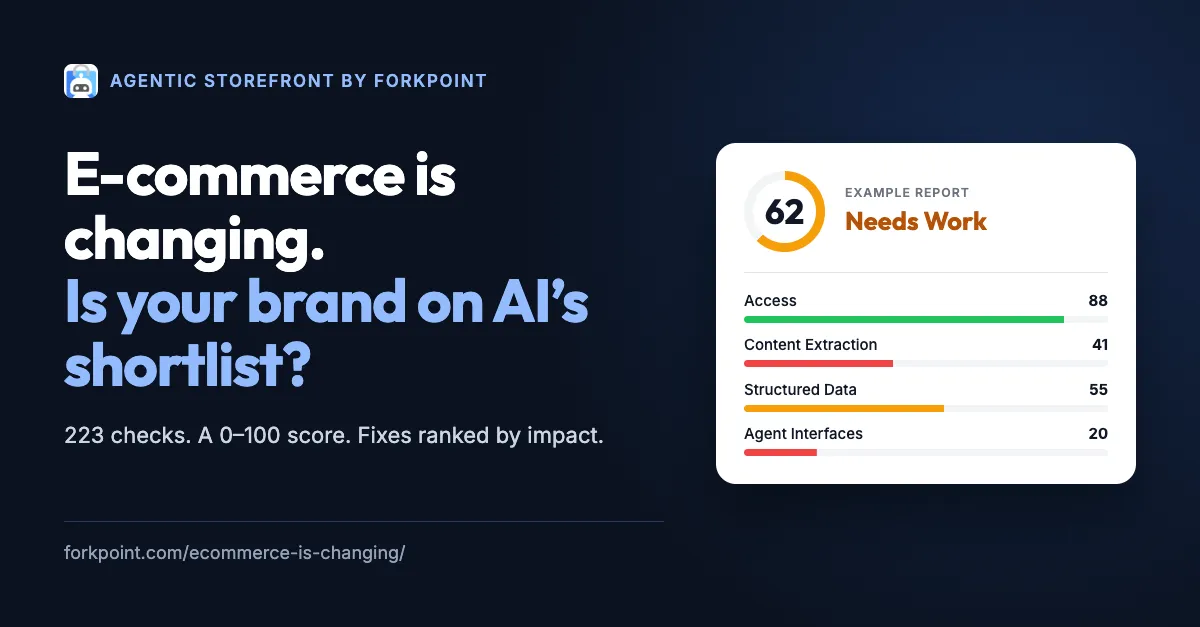
Agentic Storefront by ForkPoint provides a starting point for page-readiness work. Its score does not measure how often an assistant recommends a brand. It does not prove a sale. Check the report scope and the current product terms before using the result in a business case.
Get the free Shortlisted playbook for a 30-day plan and a worksheet for the first review. Then follow the report walkthrough to turn a finding into a task. The AI readiness guide brings the steps together.
Start with a product that matters to the business. Find one issue that the team can verify. Fix it, check it again, and use that evidence to choose the next step.