What to build beyond your website: a knowledge catalog for AI agents

Your next customer may ask an AI assistant a question before they visit your store. They may compare products, check costs, or ask about delivery inside that conversation. Your business needs clear answers wherever that research starts.
Keep your website. Build a reliable business knowledge catalog alongside it. Use that catalog to keep your product pages, customer answers, and connected systems consistent. Then check what tools can read with Agentic Storefront by ForkPoint.
AI search changes where the decision starts
A shopper might once have searched for “walking shoes” and opened several stores. Now they can ask, “Which waterproof walking shoes suit wide feet and cost less than €150?” Follow-up questions can cover fit, returns, and delivery dates.
That changes the job of your content. A broad sales message gives the assistant few facts to compare. Specific answers give the shopper useful evidence.
Pew Research Center studied the browsing activity of 900 US adults in March 2025. Users clicked a traditional result on 8% of visits to Google search pages with an AI summary. The rate reached 15% on pages without one. Users clicked a link within the summary on 1% of visits to pages with a summary. These figures describe that sample and period. They do not predict your store’s traffic.
Your website still matters. Buyers need a place to check the offer, contact your team, and complete a purchase. AI tools also need accessible source material. Google’s guidance for AI search features keeps core SEO practices relevant. It states no special optimization requirement for AI Overviews or AI Mode.
Build a business knowledge catalog
A knowledge catalog is a maintained set of facts about your business. Here, the term describes an internal business asset. It does not name a Google registration scheme or a required AI file format.
Start with the systems you already use. Your product information system can own specifications. Your commerce platform can own prices and stock. Your help center can hold approved answers. A shared record can link each fact to its source, owner, and review date.
Include the information a buyer needs:
- Products and services: names, identifiers, variants, specifications, and service areas.
- Prices: currency, tax context, current offers, or useful ranges with clear conditions.
- Availability: stock by variant and market, or current booking options.
- Policies: delivery, returns, cancellation, warranty, and support terms.
- Proof: credentials, approved case studies, and genuine reviews with their source.
- Customer questions: plain answers to recurring questions about fit, use, cost, and limitations.
- Actions: purchase, booking, support, and order-status paths with clear terms.
Assign one owner to each type of fact. Set a review date. Update the source when the fact changes. Avoid a second catalog that drifts away from live prices or stock.
Publish prices with useful context
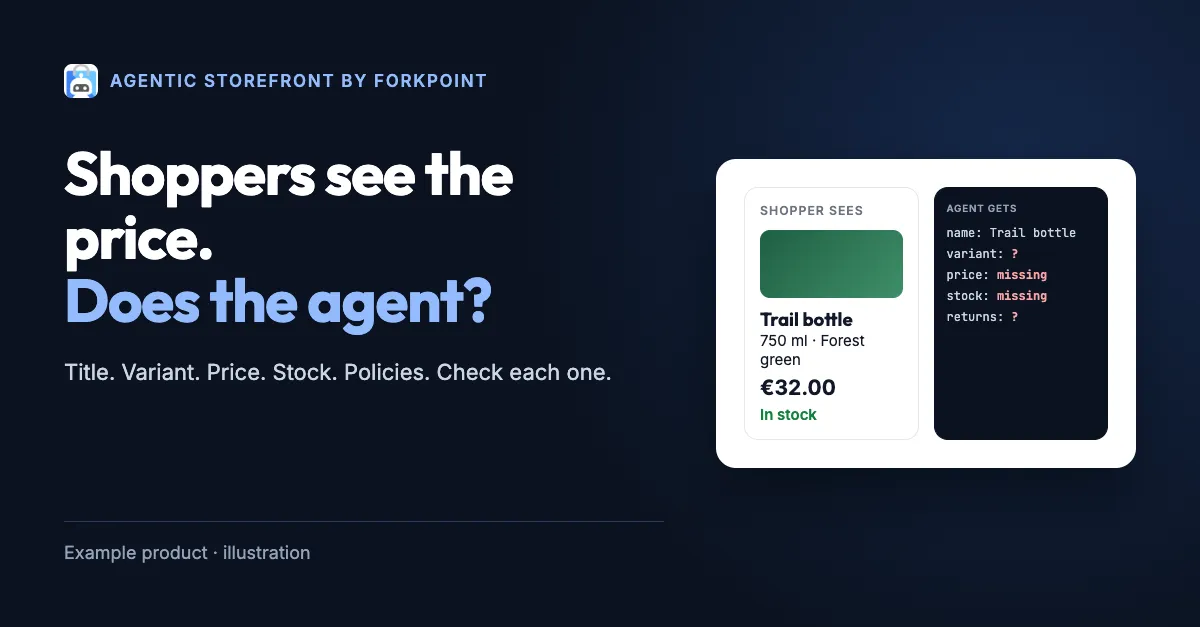
A shopper cannot compare an offer from “contact us for details” alone. Publish exact prices where the offer supports them. Use ranges where the final cost depends on the work.
For example, a service business could explain the factors behind an installation quote. A store could explain delivery charges, optional accessories, and return costs beside the product price. Label any sample price as an example.
Keep public pages, structured data, and channel feeds consistent for the same product, market, and time. Give a range its conditions and review date. Do not promise that publishing a price will win an AI citation.
Turn real questions into useful answers
Use the questions your sales and support teams hear each week. “Will this fit a wide foot?” is a better starting point than another broad list of shopping tips.
Answer from your own evidence. Include a sizing note, a measured specification, an approved customer example, or a clear product limitation. State who the product suits. Explain when another option fits better.
A template can help organize that work. Changing a city, year, or keyword does not create new expertise. Add facts that make the answer useful to that buyer.
Use calls and emails to find topics. Remove personal details before drafting. Publish an approved answer rather than a private transcript. Ask the product or service owner to check it before release.
Make facts readable and actions testable
Put key facts in accessible page text. Use headings and descriptive links. Keep structured data consistent with the visible offer. Confirm crawler access under your intended access policy.
Use your existing booking or commerce system for actions. Ask the provider which agent integrations it supports today. Check availability and scope before you plan around a roadmap item.
Test the full task for each supported integration. Can the agent select the right variant or time slot? Can it show the total cost and terms? Does the buyer approve the action? Does the system return a confirmation? Can the buyer cancel or retry safely?
A protocol or API can expose an action. Its presence alone does not prove a completed order. Keep purchase and booking tests separate from checks of page content.
Start with Agentic Storefront
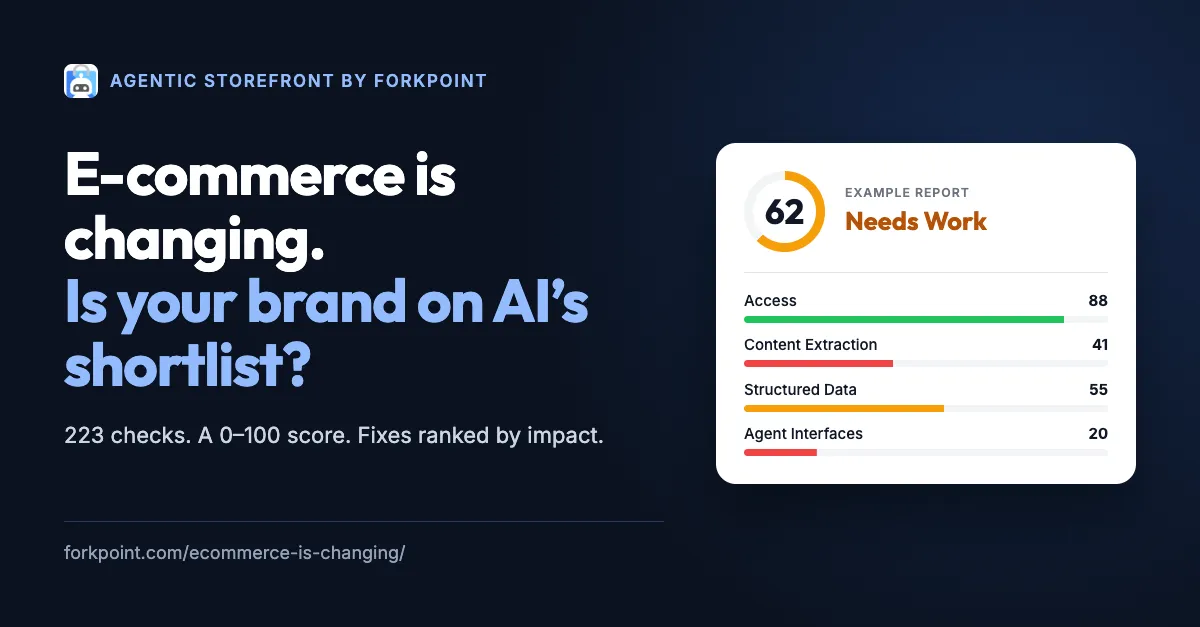
Before you buy another content tool or commission an integration, check one important page. Agentic Storefront by ForkPoint assesses page readiness across access, content extraction, machine discovery, structured data, answer readiness, agent interfaces, agentic commerce, and operability.
The report gives your team findings and evidence for the scanned page. Use it to choose a specific fix. A missing price may need a template change. An unclear policy may need a content owner. A broken action may need a separate integration test.
Run the free Agentic Storefront audit. The public offer provides a score without an account. A free account opens the full report. See the sample report before you start if you want to inspect the output.
A readiness score does not measure AI mentions, search rankings, or sales. One page does not establish the state of the full store. Use the report walkthrough to turn a finding into a task. ForkPoint also offers expert help with report findings.
Give the team five next steps
- Publish clear price information. Include the conditions behind each offer.
- Review one action path. Test a purchase or booking in a supported environment.
- Answer five customer questions. Use facts from the people who own the product or service.
- Create the first catalog records. Record the source, owner, and review date for each fact.
- Audit one page and repeat the check after a fix. Keep the URL, market, date, and result.
Track AI visibility separately. Use a fixed set of customer questions across named tools. Record the date, model where available, cited sources, and factual errors. Treat the results as observations of those answers. A mention does not prove a sale, and a missing mention does not prove a crawl failure.
Your first useful result is a business fact that buyers and tools can both read. Build from there. Get the Shortlisted playbook for the campaign’s 30-day plan, or start with the free audit above.