BACKGROUND
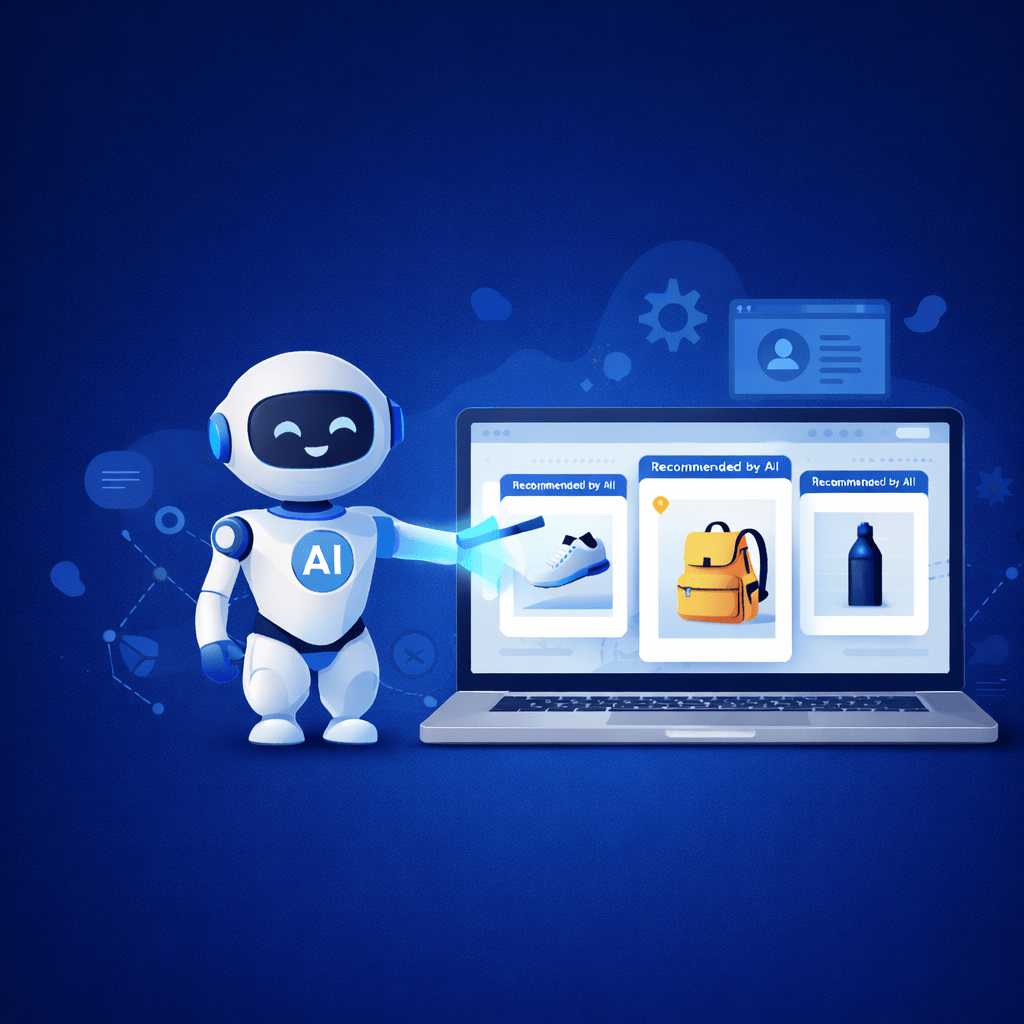
As AI assistants increasingly mediate shopping decisions, many brands are discovering an uncomfortable truth:
they exist online—but not inside AI-driven discovery.
However, traditional custom branding workflows are time-consuming, designer-dependent, and often frustrating for end users.
We partnered with a mid-market retail brand to help them transition from being AI-invisible to AI-discoverable and recommendable. By restructuring product data, enriching semantic context, and optimizing for machine readability, we enabled the brand to appear in AI-powered product recommendations and early-stage buying conversations.
From the beginning, the brand’s vision was clear:
“We want to be present wherever buying decisions begin—especially as AI becomes the first point of discovery. We don’t want to chase shoppers after the fact. We want to be the brand AI confidently recommends from the start.”
This engagement demonstrates how Invisible Commerce is already shaping retail outcomes—and how brands can act before visibility gaps become revenue gaps.
BUSINESS CHALLENGE
The Challenge: Strong Brand, Weak AI Presence
The brand had invested heavily in:
- SEO and content marketing
- Paid media across search and social
- E-commerce platform upgrades
Yet performance signals were trending in the wrong direction:
- Organic discovery plateaued
- Cost per acquisition increased
- High-intent traffic declined
- Attribution became harder to track
At the same time, consumer behavior was shifting. Customers were increasingly asking AI assistants:
- “What’s the best product for…?”
- “Which brand should I buy?”
- “Compare options for me.”
Despite strong products and reviews, the brand was rarely surfaced by AI systems.
They weren’t losing on price or quality.
They were losing on machine understanding.
WHY THE BRAND WAS INVISIBLE TO AI?
We performed a comprehensive AI Visibility Audit, analyzing how the brand’s data was interpreted across AI-driven environments.
Key findings included:
- Product data scattered across multiple systems
- Inconsistent attribute naming and formatting
- Missing or incomplete structured fields
- Limited semantic context (use cases, audience, differentiation)
- Feeds designed for humans—not AI reasoning
As a result, AI systems lacked the confidence to:
- Compare products accurately
- Recommend them reliably
- Position the brand as a default option
AI couldn’t “see” the brand clearly enough to recommend it.
THE SOLUTION: Building AI-Ready Commerce
Our team approached the engagement with one guiding principle:
“If AI can’t understand your product, it can’t sell it.”
The goal wasn’t to tweak feeds or add more data, but to rebuild how the brand’s products were understood by machines from the ground up.
Phase 1: Establishing AI Visibility
approached the engagement with a clear understanding: AI visibility is not a single optimization—it’s a system. The objective was not to make incremental adjustments, but to rebuild how the brand’s products were understood by AI from the ground up.
Phase 2: Creating a Machine-Readable Foundation
With visibility gaps identified, we restructured the brand’s product data to make it machine-readable, consistent, and complete. Disconnected data sources were aligned into a unified representation, attributes were standardized, and ambiguities were removed.
This phase created a stable foundation that AI systems could reliably ingest, compare, and reason over.
Phase 3: Adding Semantic Intelligence
Once the data foundation was in place, we focused on meaning. Product information was enriched with contextual signals that explained who each product was for, the problems it solved, and how it differed from alternatives.
This semantic layer allowed AI systems to move beyond basic indexing and toward confident recommendation, understanding not just what the product was, but why it mattered.
Phase Four: Unifying and Optimizing for AI
In the final phase, ForkPoint unified all product intelligence into a single AI-optimized source of truth and implemented a continuous optimization loop. As AI systems evolve and new discovery behaviors emerge, the brand’s data evolves alongside them.
AI visibility became an ongoing capability rather than a one-time project.
Together, these phases delivered more than improved discoverability. They created a durable, AI-ready commerce foundation—one designed to keep the brand visible as Invisible Commerce becomes the default mode of shopping.
RESULTS & BUSINESS IMPACT
| 📊 Metric | Before | After |
|---|---|---|
| 🤖 AI Product Recommendation Presence | 8% | 42% |
| 🔍 AI-Generated Product Mentions / Month | 120 | 690 |
| 📦 Product Data Completeness Score | 64% | 96% |
| 🧠 Accuracy of AI Product Descriptions | Inconsistent | Highly accurate |
| 🚀 High-Intent Traffic from AI Touchpoints | Baseline | +28% |
| 💰 Conversion Rate (AI-Adjacent Sessions) | 2.1% | 3.4% |
These results marked a fundamental shift:
the brand moved from being absent in AI conversations to being confidently recommended at the moment of intent.
Instead of competing only on traditional channels, the brand gained visibility inside AI-driven discovery – where buying decisions increasingly begin.
WHY THIS MATTERS: The New Retail Battleground
This case study highlights a critical shift:
- Discovery is moving upstream
- AI is becoming the gatekeeper
- Visibility is no longer guaranteed
Brands that optimize for Invisible Commerce now gain:
- Earlier access to buyer intent
- Higher-quality recommendations
- Compounding visibility advantages
Those who wait risk disappearing quietly – without realizing why.
CONCLUSION
AI assistants are already influencing what people buy.
The only question is whose products they recommend.
We help brands take control of their AI presence by transforming product data into AI-ready intelligence.
👉 Reach out to ForkPoint if you want to audit your AI visibility, strengthen your product data, and ensure your brand shows up where buying decisions now begin.
Don’t wait for competitors to take the lead.